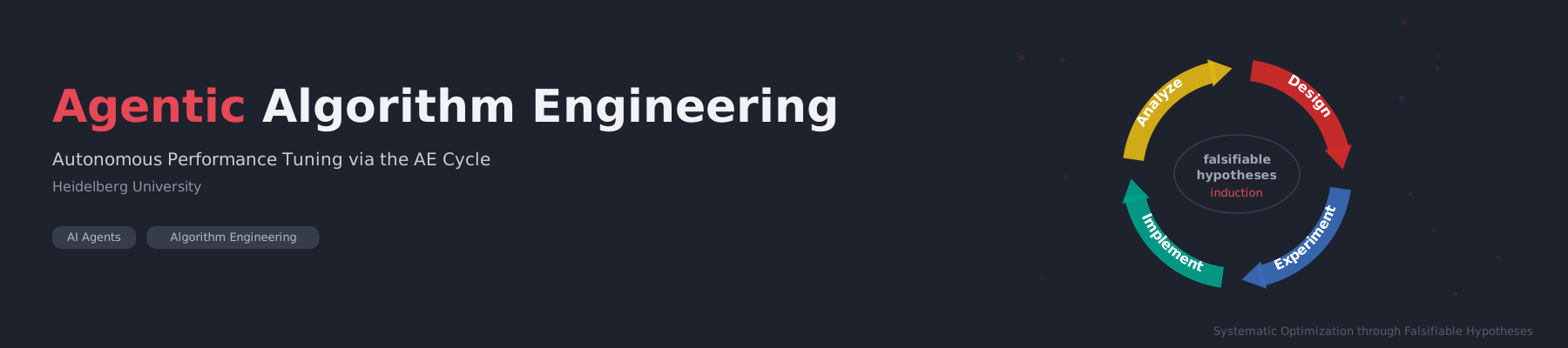
This repository contains the program definition for Agentic Algorithm Engineering (AAE), a methodology that turns autonomous agents into performance engineers following the Algorithm Engineering cycle: design, analysis, implementation, and experimental evaluation, driven by falsifiable hypotheses.
See AAE.md for the full program definition.
Algorithm Engineering, as defined by Sanders (2009), is a methodology for algorithmic research built around a cycle of design, analysis, implementation, and experimental evaluation. Unlike traditional algorithmics, which often stops at theoretical analysis, algorithm engineering insists on closing the loop: hypotheses about algorithm performance are tested experimentally on realistic inputs, and the results feed back into improved designs. Central to this process are falsifiable hypotheses, following Popper's scientific method applied to algorithms.
Agentic Algorithm Engineering takes this methodology and hands the cycle to an autonomous AI agent. The agent formulates hypotheses, implements changes, runs experiments, and evaluates results, iterating continuously without human intervention. This allows systematic, high-throughput exploration of the optimization space while maintaining the scientific rigor of the AE methodology.
The agent must run in a mode that does not require user input, since the AE cycle is designed to run autonomously and indefinitely. If you are using Claude Code, launch it with --dangerously-skip-permissions (byPassPermissions mode). For other agent frameworks, ensure that all tool calls (file edits, shell commands, git operations) are auto-approved so the loop can proceed without interruption.
Christian Schulz, Algorithm Engineering Group, Heidelberg University
We welcome contributions! Feel free to open a pull request if you have improvements, extensions, or new ideas.

